
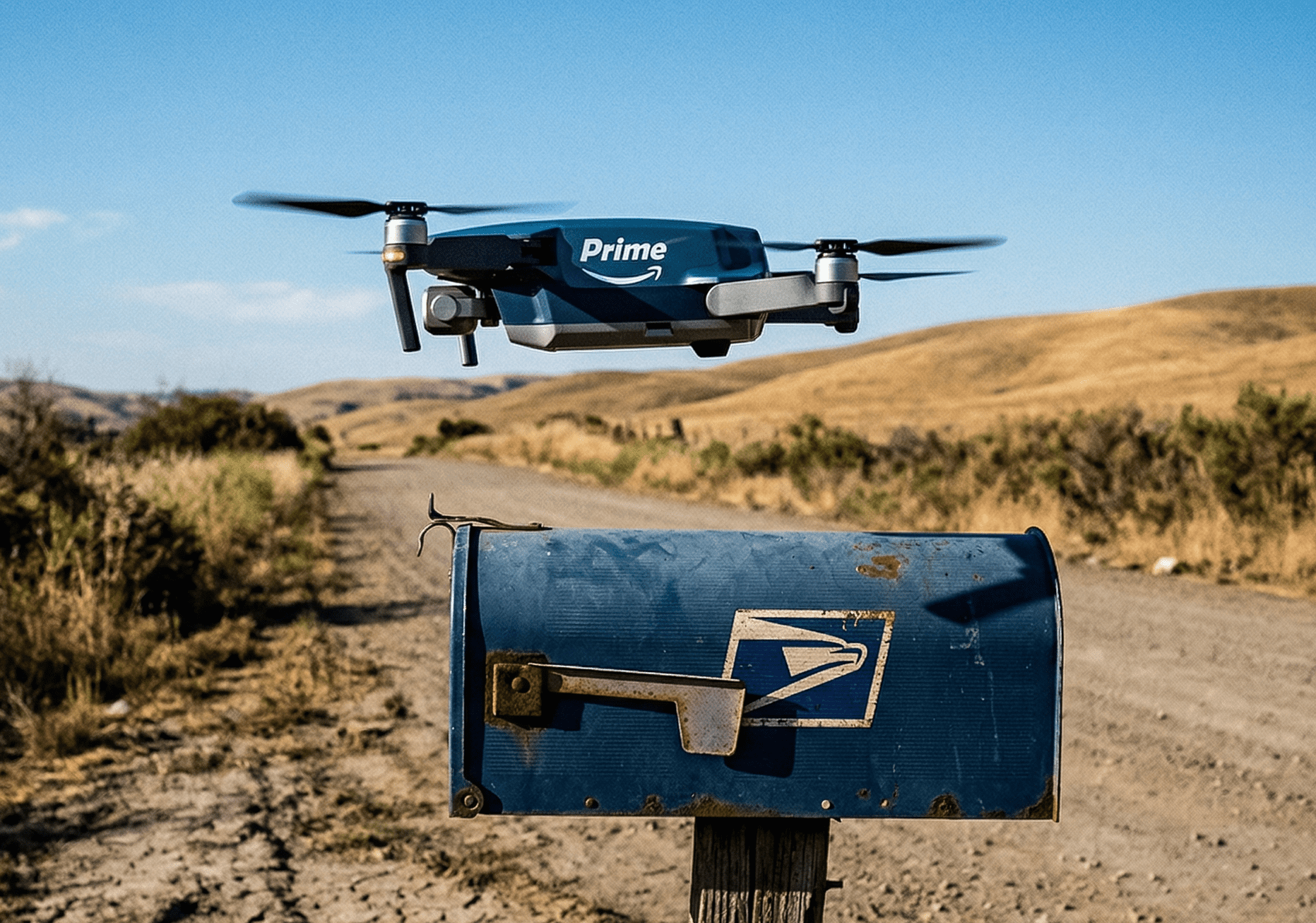
Amazon just saved the U.S. Post Office. Your shipping rates are about to spike. Data reveals the end of public logistics.
I was looking at the latest Reuters report while finishing my morning coffee.
Amazon just shook hands with the U.S. Postal Service on a deal that keeps 1 billion packages a year in those little white trucks.
For a moment, the world of logistics exhaled.
The USPS was looking at a two-thirds cut in Amazon’s volume, which would have been a death blow.
Instead, Amazon is keeping 80% of its business with the government agency.
It looks like a win for the underdog, right?
If you dig into the numbers as I do, you’ll see it’s actually the most expensive “stay of execution” in history.
And if you own a business, you are the one paying for the blindfold.
The Problem: Your Shipping Strategy is a Ghost Ship
Most of you are still operating on the 2015 “click and ship” mindset.
You think that because the Post Office exists, your ability to reach customers is guaranteed.
You see those blue boxes on every corner and feel a sense of security.
But that security is an expensive illusion.
The USPS has operated at a massive loss for nearly 20 years.
In fiscal year 2025 alone, they posted a net loss of $9 billion.
Package volume for the agency is dropping like a stone—down over 12% in the first quarter of 2026.
When a partner is losing billions and shipping fewer items, they don’t get better.
They get more expensive.
They get slower.
And they get desperate.
The Agitation: Amazon isn’t Your Partner, It’s Your Replacement
Amazon didn’t sign this deal because they love the Post Office.
They signed it because they aren’t quite ready to kill it yet.
Last year, for the first time in history, Amazon’s private logistics arm delivered more packages than the USPS.
6.7 billion parcels moved through Amazon’s own vans and planes.
They are already the largest carrier in the United States.
While the USPS is begging for price hikes—like the proposed $0.95 stamp—Amazon is spending $4 billion to triple its rural delivery network.
They are building a private version of the government’s infrastructure.
This deal to keep 80% of their volume with USPS is just a placeholder.
It buys Amazon time to perfect its automated sorting and autonomous rural drivers.
If you are a small business relying on “standard shipping,” you are subsidizing Amazon’s research.
You are paying higher rates to a struggling agency while your biggest competitor builds a robot army to bypass them.
Your “safe” shipping choice is actually a trap that ensures you will always be slower than Prime.
In the 2026 economy, “slow” doesn’t just mean a late package.
It means a cancelled subscription and a one-star review.
The Solution: Automating the Last Mile Before You’re Priced Out
The “After” state isn’t just about switching to a different carrier.
It’s about moving your business logic into the AI era.
We have to stop thinking about shipping as a “cost of doing business.”
We have to start seeing it as a data problem that can be automated.
Amazon wins because they know exactly which packages to give to the USPS and which to keep for itself.
They use agentic AI to route deliveries based on real-time fuel costs, driver density, and weather.
You can do the same thing on a smaller scale.
The cure for the “postal tax” is implementing smart automation that shifts your fulfillment strategy in real-time.
By using automated logistics platforms, you can bypass the “one-size-fits-all” shipping trap.
You can identify the exact moment a private carrier becomes cheaper than a public one.
You can use local delivery “pods” and automated inventory placement to keep your stock closer to the customer.
The goal is to stop being a passenger on the USPS ship.
You need to build your own mini-logistics network that doesn’t care if the Post Office raises rates by 8% next month.
When you automate your supply chain, you stop reacting to the news.
You start making the news.
You move from a business that “sends stuff” to a business that “delivers value” at light speed.
The data is clear: the public infrastructure is crumbling under the weight of its own debt.
Amazon has already moved on.
The question is, why haven’t you?
If you’re ready to stop paying the “obsolete tax,” let’s look at how we can automate your growth.
Check out how we’re rebuilding small business logistics at cirrusautomations.com.
Or, if you want to see the framework in action, head over to landingpageonecirrus.netlify.app/.
Don’t wait for the next 10-K to tell you what you already know.
The future of delivery is private, automated, and already here.
References:
- Reuters: Amazon strikes deal with USPS that maintains 80% of package volume
- U.S. Postal Service: Fiscal Year 2025 Annual Report (Form 10-K)
- U.S. Postal Service: First Quarter Fiscal Year 2026 Results
- ShipMatrix: 2025 Parcel Carrier Volume Analysis
- Amazon.com: 2025 Annual Report (Form 10-K)
- EcommerceBytes: USPS to Retain Bulk of Amazon Package Business
- SupplyChainBrain: Amazon Becomes the Largest Parcel Carrier in the U.S.