
I. The Transformation of a Giant
For decades, Dollar Tree was known for one thing: everything costs a dollar. But as inflation hit and the world changed, that model became a trap. In their recent 10-K (March 2026) and 10-Q (December 2025), we see a company that has successfully shed its “Family Dollar” baggage to become a lean, tech-heavy machine.
The company’s AI Readiness Score sits at 68/100. They are no longer just a “discount store”; they are an “AI-enabled enterprise.”
II. The Risks: What Keeps Retail CEOs Awake?
According to the filings, three major risks dominate their strategy:
- Inventory Shrink: Retail theft and administrative errors are eating margins.
- Macro-Volatility: With tariffs and wage hikes, they can no longer afford “dead weight” on their shelves.
- The Multi-Price Transition: Moving to $3 and $5 items is risky. If they pick the wrong product for the wrong neighborhood, the inventory sits and rots.
III. The Solution: “Shelf Productivity” via AI
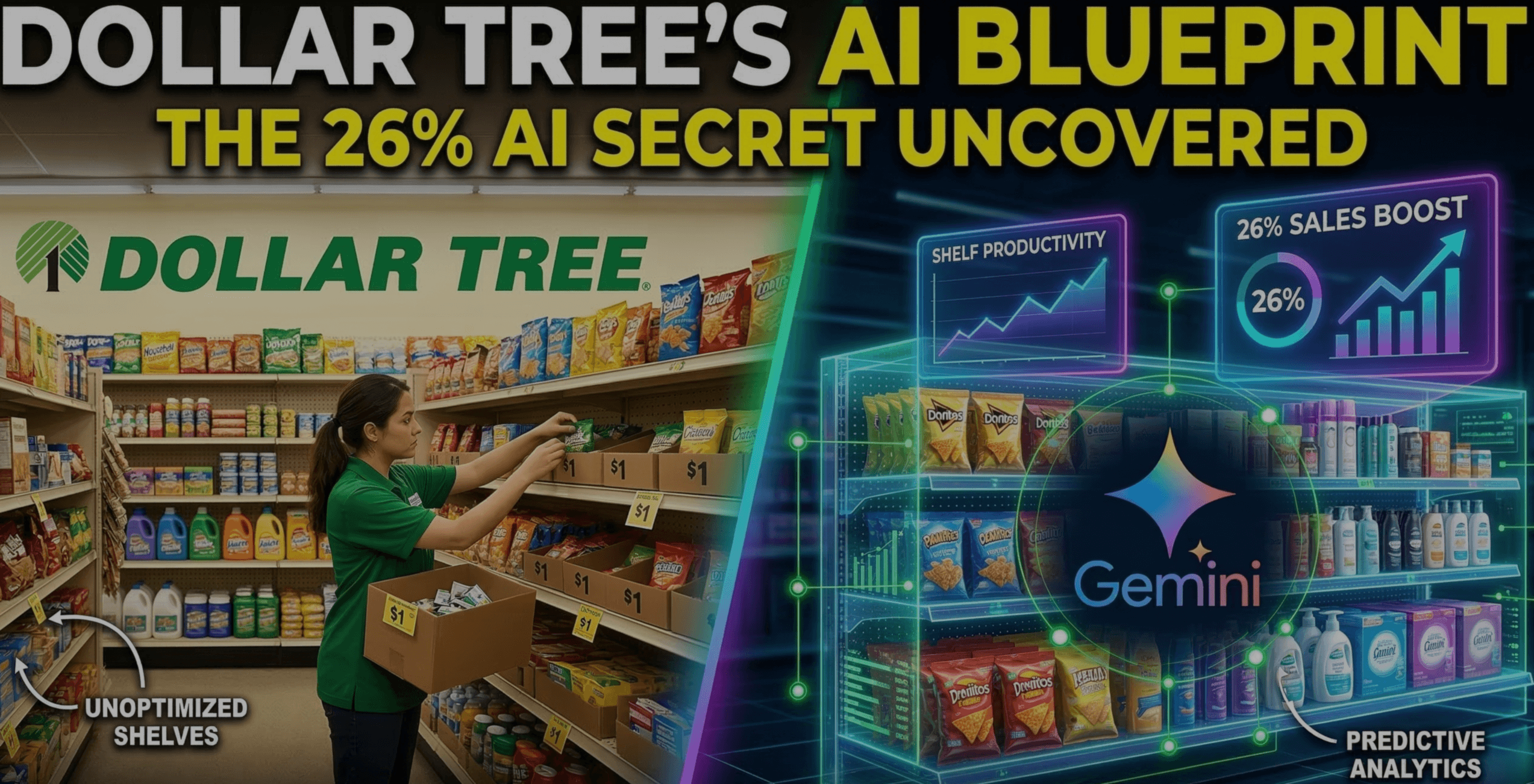
Dollar Tree’s biggest win wasn’t a new marketing campaign—it was Automation. By using predictive analytics, they identified “underperforming” shelf space. By swapping low-margin items for high-velocity ones, they saw a 26% lift in specific categories.
This is “Algorithmic Pricing” and “Space Optimization” in action.
IV. Tutorial: Building the “DIY Shelf Optimizer”
You don’t need a team of data scientists to do this. Here is how you can use the Google + Make.com stack to act like a Fortune 500 CEO.
Phase 1: The Foundation (Google Sheets). Set up a simple tracker. Columns: Product Name, Price, Unit Sales, Shelf Position (A1, B2, etc.), and Category.
Phase 2: The Logic (Google Gemini) Gemini 1.5 Pro is your consultant. It can process massive amounts of data (your sales) and compare it against its “knowledge base” of market trends.
Phase 3: The Automation (Make.com) This is the “glue.”
- Trigger: Schedule a “Search Rows” module in Make.com for every Sunday at 11:00 PM.
- Action: Pass those rows into the Gemini “Create a Prompt” module.
- Prompt Engineering: Use this: “You are a retail inventory specialist. Examine the attached sales data. Identify the ‘Bottom 10%’ of performers. Based on [Current Season/Trend], recommend 3 products I should test in those physical spots to increase my average transaction value.”
Phase 4: The Delivery. Have Make.com send the output to your
Google Calendar as a “Monday Morning Strategy” meeting or an automated email to your store manager.
V. Why the “Small Player” Has the Advantage
Dollar Tree is spending millions to integrate these systems into 16,000+ stores. You can implement this in one store or one e-commerce site in about 30 minutes.
The “Readiness Gap” is closing. In 2026, the winner isn’t the one with the most money; it’s the one with the best workflow.